



By Evans Jona
NEW ZORORO, MUTARE — In the narrow lanes of New Zororo, Sakubva, where unemployment is a part of everyday life, a quiet revolution is taking place inside darkened rooms. These rooms, lined with black plastic, are home to a small but transformative agricultural project that is changing the lives of women, youth, and vulnerable households.
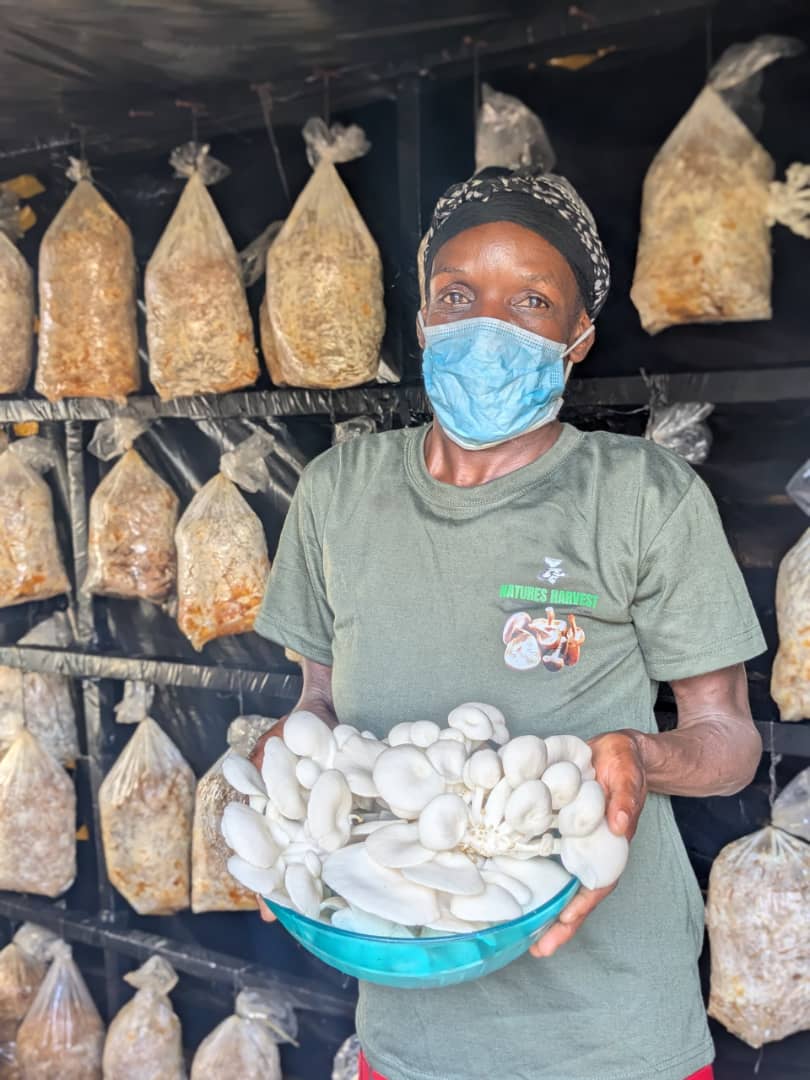
Nature’s Harvest, a mushroom farming venture, was started by widow Tichada Chadzingwa in October 2025. What began as a personal means to earn a living has blossomed into a project that provides food, income, and a sense of purpose to residents of this high-density suburb.
“I started this project out of passion, but also necessity,” Chadzingwa told this reporter. “I needed something that could give me a steady income quickly, and mushrooms offered exactly that.”
She chose oyster mushrooms after careful consideration. The crop requires minimal labor, grows fast, and can thrive in small indoor spaces. The mushrooms also offer a consistent harvest year-round, even during periods of drought, making them a reliable source of income for small-scale urban farmers.
“Mushrooms are not labour-intensive, and you don’t need acres of land,” Chadzingwa explained. “You harvest in just three to six weeks, and the market is always there.”
Chadzingwa deliberately structured the project to benefit young people, women, families, and other vulnerable groups often excluded from conventional economic opportunities.
This is a low-barrier but high-impact business,” she said. “You don’t need prior experience, you don’t need a lot of money, and income comes quickly. It’s a way to create your own opportunity when jobs are scarce.”
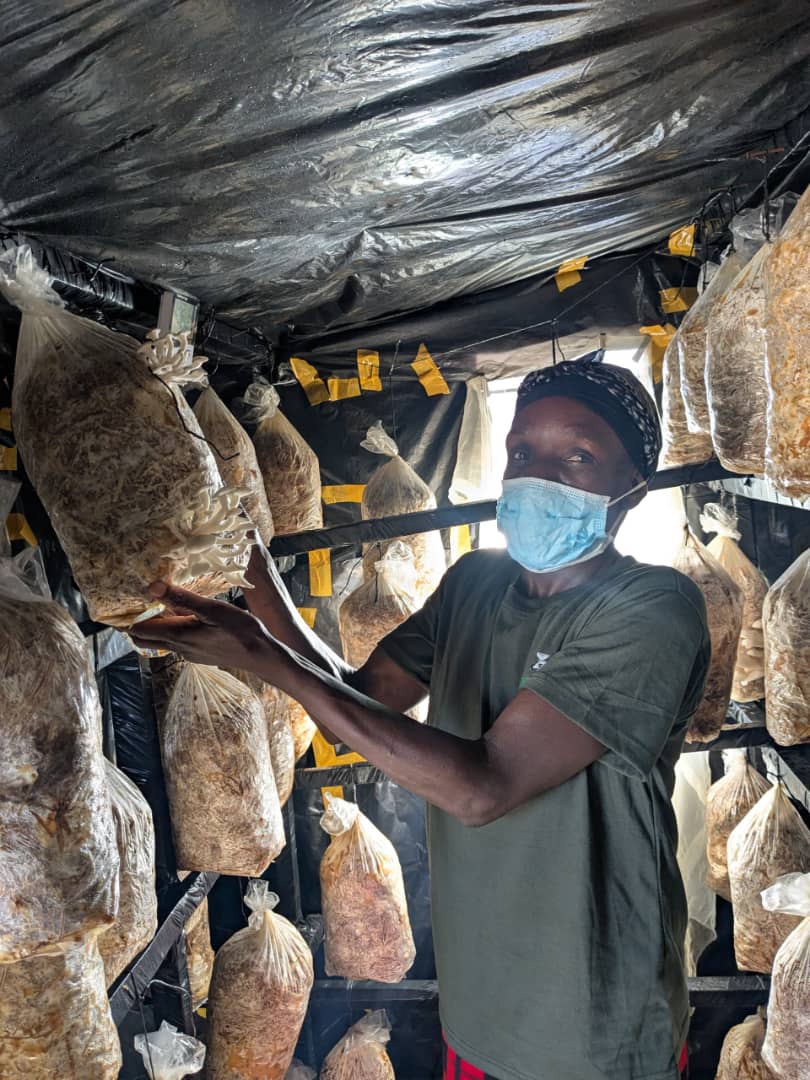
The production process, while simple once learned, is highly meticulous. Substrates such as wheat straw, sawdust, and cotton husks are soaked overnight, drained, and then packed into plastic bags with mushroom spawn, the seed that initiates growth. The layering process is precise: substrate, spawn along the edges, more substrate, and spawn repeated several times until the bag is full. Small holes are then punctured in the bags to allow air circulation and excess moisture to escape.
“The packing process is very important,” Chadzingwa said. “You have to layer the substrate and the spawn correctly. If you get the measurements wrong, the mushrooms won’t grow. Knowledge is everything in this business.”
The bags are then placed on shelves in a dark room for an incubation period of 21 days. During this time, they remain largely untouched, allowing the spawn to colonize the substrate. After the incubation period, air circulation is increased, and the mushrooms begin to grow rapidly. In the first flush, Nature’s Harvest can harvest twice daily, providing quick and consistent returns.
Despite the project’s promise, Chadzingwa faced significant challenges in the early stages. Maintaining the right humidity and temperature was particularly difficult. High temperatures and low humidity caused mushrooms to dry out, threatening the viability of the venture.
“The temperatures were too high and the humidity was very low,” she recalled. “The mushrooms were getting dry as they were coming out. It was frustrating at first.”
The turning point came when she invested in a hydrometer, a device that measures and regulates both humidity and temperature. “Once I had the right equipment, the mushrooms started doing really well,” she said. “That’s when I realized the full potential of this project.”
Today, Nature’s Harvest is more than a source of income for Chadzingwa. It contributes to food security and supports household budgets in New Zororo. Residents collect mushrooms directly from her home, and demand has been consistently high.
“At the moment, I don’t face transport challenges,” she said. “People come directly to collect because the demand is very high.”
Chadzingwa has big plans for the future. She hopes to expand production, train others, create jobs, and eventually supply bulk buyers or even export markets. “Because of the demand, I need a bigger space,” she said. “With financial support, I can scale this project and create more opportunities for people in our community.”
She also emphasizes the importance of training and hands-on experience for anyone interested in mushroom farming. “The measurements are very important,” she said. “When mixing lime and chlorine with the substrate, you must get it right. If you don’t, things can go very wrong.”
Chadzingwa believes that small-scale urban agriculture projects like hers need support to thrive. Access to finance, quality inputs, practical training, and reliable market linkages are crucial for sustainability.
To young people who may think agriculture is not for them, Chadzingwa offers a different perspective. “Mushroom farming is smart, modern agriculture. It’s climate-controlled, eco-friendly, and fast-growing,” she said. “You don’t wait for a job, you create one.”
For Chadzingwa, Nature’s Harvest is about more than growing mushrooms. It is about growing dignity, opportunity, and hope in a community that needs it most.
“This is more than farming mushrooms,” she said. “It’s about giving people a chance to build their futures.”
In a small, darkened room in New Zororo, the sprouting of oyster mushrooms has become a symbol of resilience and entrepreneurship, proving that even in constrained urban spaces, small ideas can yield massive impact.
About The Author



More Stories
Good Start, Grim Outlook
From Connectivity to Clean Cities, NetOne Takes Part in National Clean-Up Day
Anticipatory Health Action Activated in Masvingo After La Niña Flooding