



From COPAC Architect to Amendment Backer…
By Staff Reporter
Zimbabwe’s political landscape is once again gripped by an intense constitutional debate as growing voices, including retired military commanders and liberation war veterans, challenge the legitimacy of the proposed Constitutional Amendment Bill No. 3, warning that the process risks undermining the very democratic ideals upon which the nation was founded.
The latest intervention comes from Air Marshal (Rtd) Henry Muchena, who submitted a detailed memorandum to Parliament on March 12 2026 on behalf of a group of unnamed retired generals and senior civil servants who are themselves veterans of Zimbabwe’s liberation struggle.
In the submission, the former commanders warned that the proposed constitutional amendments threaten the principle that sovereignty ultimately belongs to the people.
“We write to you today not as rebels, not as dissenters, and not as enemies of the party to which we have given our entire lives,” the retired commanders said in the document. “We speak as men who were present when this nation was being born in blood and fire.”
The submission was made after Parliament opened a 90-day public consultation process on the bill, a process critics say has already been clouded by controversy, political tensions and accusations that civic groups are being prevented from freely expressing their views.
At the centre of the debate is a proposal that could significantly alter Zimbabwe’s political architecture. Among the key provisions contained in the bill is the repeal of Section 92 of the constitution, which currently provides for the direct election of the president by citizens.
Under the proposed changes, the President would instead be elected by a joint sitting of Parliament, a move critics argue could weaken the principle of direct popular sovereignty.
The bill also proposes extending the terms of the president and Parliament from five to seven years, a change that could potentially allow Emmerson Dambudzo Mnangagwa to remain in office beyond the current constitutional timeline. Mnangagwa, who was elected in 2023 for what is widely understood to be his final term under existing constitutional limits, is expected to leave office in 2028. The proposed amendment could extend that tenure to 2030.
The proposed changes have sparked fierce resistance from sections of Zimbabwe’s political spectrum, including some individuals who were instrumental in drafting the country’s current constitution.
One of the most notable figures caught in the crossfire is Paul Mangwana, a former co-chairperson of the Constitution Parliamentary Committee (COPAC) that oversaw the drafting of Zimbabwe’s 2013 Constitution.
Mangwana had previously played a central role in the extensive national consultation process that led to the adoption of the current constitution through a referendum. Critics now accuse him of “flip-flopping” by supporting amendments that appear to sidestep the very democratic safeguards he once helped champion.
Political analysts, Jealousy Mawarire, say the contradiction raises serious questions about the integrity of the constitutional reform process.
“The same individuals who insisted that the 2013 constitution must be endorsed through a referendum are now comfortable with fundamental amendments being pushed through Parliament alone, that is a serious departure from the spirit of COPAC,” said Mawarire.
The retired military commanders echoed similar concerns in their submission to Parliament, invoking the ideological foundations of the liberation struggle.
They recalled the slogans that guided Zimbabwe’s independence movement in the late 1970s, Gore reMusangano (1977), Gore reVanhu (1978), and Gore reMasimba Evanhu (1980), which they said affirmed the principle that political authority ultimately resides with the masses.
“These were not mere slogans,” they wrote. “They were the covenant we made with every Zimbabwean living and dead that sovereignty would rest with the masses, not with the privileged few.”
The retired commanders warned that the proposed constitutional amendments risk concentrating political power in the hands of a small elite, drawing parallels with the colonial-era restrictions that denied the majority of Zimbabweans meaningful participation in governance.
“Are we now reversing everything we bled for through these amendments?” they asked. “Are we returning to the era of Ian Smith, when only a privileged elite had the right to participate in governance?”
According to the submission, the liberation struggle was fought on two fundamental pillars, land and universal adult suffrage.
“These were not negotiable then, and they must not be negotiable now,” the document states.
The retired commanders also invoked a historic declaration made in 2002 by the late Vitalis Zvinavashe, who famously argued that Zimbabwe’s leadership must always align itself with the principles of the liberation struggle.
“We declared that leadership must fit into a straitjacket of principle,” the submission recalled. “The party does not reshape itself around the appetites of its leaders. Leaders reshape themselves around the values of the party and the will of the people.”
Retired officers, the solution is straightforward, if the proposed amendments are truly in the national interest, they must be subjected to a national referendum.
They pointed to the year 2000 constitutional referendum, when voters rejected a government-backed draft, as an example of democratic accountability that should guide current political leaders.
“In 2000 Parliament did what was correct by referring constitutional proposals to the people,” they wrote. “The people rejected our proposal and we accepted the outcome.”
The same principle, they argue, should apply today.
“Call a referendum,” the group urged. “Let the same Zimbabweans who gave us the 2013 constitution speak again.”
The position of the retired generals has since received backing from the Zimbabwe National Liberation War Veterans Association (ZNLWVA), which issued a statement affirming that the constitution remains the collective covenant of the Zimbabwean people.
In the statement signed by Andrease Ethan Mathibela, the association emphasised that the constitution adopted in 2013 was the result of an inclusive national process endorsed through a referendum.
“The Constitution is not merely a legal document,” the statement read. “It is the collective covenant of the people of Zimbabwe.”
The association warned that any attempt to amend the constitution must always be guided by the sovereign will of citizens rather than what it described as “transient political convenience or elite interests.”
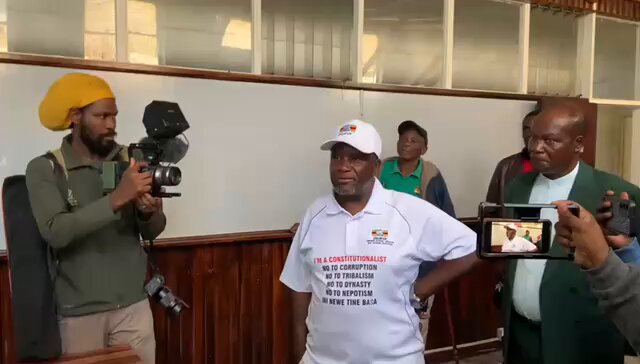
Yet as the debate intensifies, critics say the environment for open public discussion is shrinking.
Reports have emerged that police have been deployed to block certain civic gatherings and meetings organised by civil society groups seeking to debate the proposed amendments. Some activists claim that private meetings have been disrupted or denied permission altogether, creating what they describe as a climate of intimidation around the constitutional consultation process.
Civil society organisations argue that such restrictions contradict the spirit of public participation that defined the drafting of the 2013 constitution.
Despite the criticism, the retired commanders stressed that their intervention should not be interpreted as hostility toward the ruling party.
“We are ZANU-PF. We have always been ZANU-PF. We will die ZANU-PF,” they wrote, describing themselves as “stockholders” in the party forged through their sacrifices during the liberation war.
However, they insisted that the national constitution belongs to all Zimbabweans, not just the governing party.
“Democracy does not permit one party, however powerful, to reshape the nation’s foundational law without the express consent of the people,” the submission states.
For the retired commanders, the stakes extend beyond contemporary politics. They argue that altering the constitution without broad public participation would dishonour the thousands of liberation fighters who died believing they were fighting for a democratic Zimbabwe.
“We looked them in the eye and promised that their sacrifice would not be in vain,” they wrote. “Many of those comrades never came home. They died with that promise in their ears.”
Their message to Parliament was blunt and uncompromising.
“Anything less than a referendum is not a constitutional amendment,” the submission concluded. “It is a betrayal not of us, but of every Zimbabwean who ever dared to hope for a better country.”
About The Author


More Stories
Gentle Giant Of The Liberation Struggle, Chiringa Declared A National Hero
War Veterans Petition Parliament Over Controversial Constitutional Amendment
Children Pay the Price as School Oversight System Collapses