



The Post On Sunday
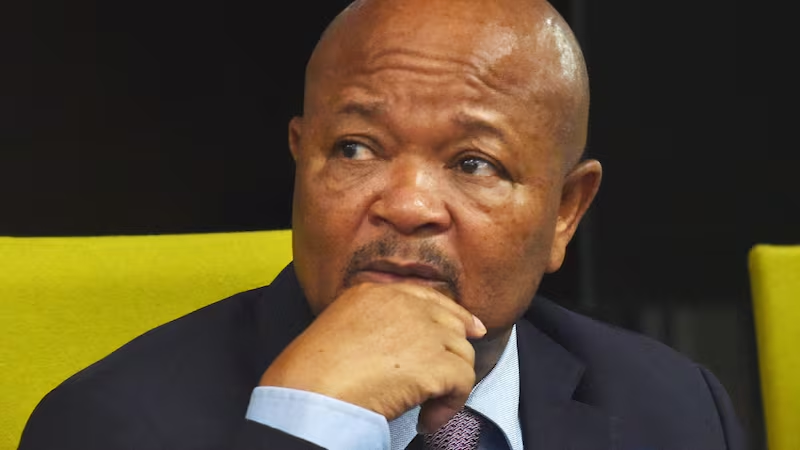
Suspended South African Police Minister, Senzo Mchunu has dismissed growing speculation and accusations linking him to alleged political interference in South Africa’s criminal justice system, declaring that he remains “unshaken” by the explosive revelations emerging from the Madlanga Commission of Inquiry.
Speaking on Saturday at a memorial lecture honouring two late anti-apartheid activists, Simon Msweli and Mike Mthethwa, in the Musa Dladla region of KwaZulu-Natal, Mchunu struck a tone of confidence and composure. The event, which was meant to reflect on the sacrifices of liberation heroes, became an unexpected platform for the embattled minister to publicly address his suspension and the swirling controversy that now defines his political life.
“I am glad that I will get an opportunity to present my side of the story in the commission,” Mchunu said to loud applause from sections of the audience. “I am not shaken by what has been said. The truth will come out.”
His comments come in the wake of his suspension by President Cyril Ramaphosa, following damning testimony by KwaZulu-Natal police commissioner Lieutenant-General Nhlanhla Mkhwanazi before the commission. Mkhwanazi accused Mchunu of meddling in police operations — an act he claimed led directly to the disbandment of the elite political killings task team that had been investigating politically motivated assassinations in the province.
The disbandment, critics argue, undermined years of work by investigators trying to unravel a web of politically linked murders that have haunted KwaZulu-Natal’s political landscape for over a decade. The province remains South Africa’s epicentre of political violence, where rivalry, power struggles, and the intersection of politics and crime have frequently turned deadly.
Mchunu’s alleged role, according to testimonies before the Madlanga Commission, extends beyond interference. Some witnesses, including high-ranking members of the South African Police Service (SAPS), have gone further, linking the suspended minister to shadowy criminal cartels accused of attempting to “capture” elements of the police service for political and economic gain.
Among those who have testified are national police commissioner General Fannie Masemola and crime intelligence head Lieutenant-General Dumisani Khumalo, both of whom reportedly confirmed that political influence had, at times, compromised operational independence within the SAPS. All three named Mchunu as a central figure in the alleged interference.
For Mchunu, however, these claims are part of what he describes as a broader attempt to “politicise policing” and tarnish his name ahead of internal political battles within the ruling African National Congress (ANC).
“There is a time for accusations, and there will be a time for truth,” Mchunu said during his address. “I have full confidence that the commission will deal with facts, not rumours.”
Despite his suspension, Mchunu’s appearance in the Musa Dladla region, a political heartland with deep historical roots in the ANC, appeared to reaffirm his enduring influence. The memorial lecture commemorated Msweli and Mthethwa, two struggle stalwarts killed in 1992 by apartheid police after allegedly firing at a police helicopter in kwaSokhulu, outside Richards Bay.
Mchunu used the platform to reflect on their sacrifices and the moral legacy of South Africa’s liberation movement, linking their courage to the values of honesty, service, and resilience, qualities he implied are now being tested in his own life.
After the memorial, Mchunu paid a condolence visit to the family of the late South African ambassador to France, Nathi Mthethwa, in kwaMbonambi village. Mthethwa, a close political ally and former cabinet colleague, passed away in Paris last week.
Visibly emotional, Mchunu described Mthethwa’s death as a profound loss.
“It is something we never expected,” he said softly. “We worked closely together from our early days in the ANC’s Northern Natal region in the 1990s. He was a man of integrity and commitment.”
As the Madlanga Commission continues its hearings, political analysts say Mchunu’s response reflects both his seasoned composure and the high stakes surrounding the inquiry. The commission’s findings could have significant implications for President Ramaphosa’s government, which has struggled to contain allegations of factionalism, corruption, and institutional capture within law enforcement agencies.
For now, Mchunu’s strategy seems to be one of calm endurance, projecting confidence while preparing for what could be the most defining test of his political career. Whether his defiance translates into vindication or further controversy will depend on how convincingly he tells his story when he finally takes the stand before the commission.

More Stories
AHF calls for African countries to unite against debt crisis
Zimbabwe’s Second Bid to Remove Vendors from Harare Streets Triggers Fresh Livelihoods, Law and Order Clash
Traffickers exploiting job seekers and vulnerable Zimbabweans, official warns