





The Post On Sunday
GAZA CITY — A fragile calm descended over Gaza on Friday morning after the Israeli military announced a partial withdrawal of troops from the besieged enclave, following a ceasefire agreement brokered under a peace plan backed by former U.S. President Donald Trump.
The Israel Defense Forces (IDF) confirmed that its units had repositioned to agreed lines inside Gaza but still occupy nearly half of the territory, marking what officials described as the “first phase” of a staggered truce aimed at ending nearly two years of relentless warfare.
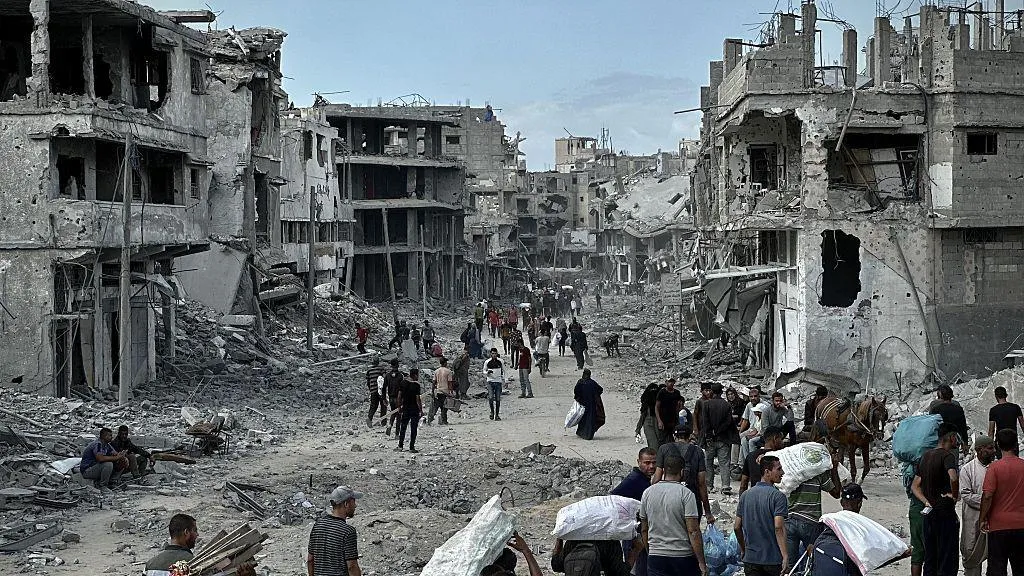
Eyewitnesses reported seeing Israeli forces retreating from the north-western outskirts of Gaza City toward the east, while in the south, troops were said to have pulled back from the battered Khan Younis area. For the first time in months, thousands of displaced Palestinians began the long journey northward, many on foot, through the rubble of their homes, waving flags and clutching what little remained of their belongings.
“The road is long and difficult; there’s no food or water,” said Alaa Saleh, a schoolteacher walking north with his family. “Even if our homes are gone, we just want to go back.”
The ceasefire, which came into effect early Friday, followed Israel’s approval of the first stage of Trump’s “hostage and peace plan.” Under the deal, Hamas has until midday Monday to release all surviving Israeli hostages, estimated at around 20, and up to 28 bodies of those killed in captivity.
In exchange, Israel will release about 250 Palestinian prisoners serving life sentences, with most expected to return to the West Bank and East Jerusalem, and others likely to be deported. A further 1,700 Palestinians detained from Gaza during the conflict are also expected to be freed.
The agreement also stipulates that humanitarian aid must flow freely into Gaza, where United Nations-backed agencies have declared a famine in parts of the territory. Some 600 trucks carrying food, fuel, and medical supplies were expected to cross daily from Friday, though by evening, aid groups said the deliveries had yet to reach the areas most in need.
“The population is exhausted, displaced, starved, and traumatised,” said a UN aid worker. “If the ceasefire holds, it could be a lifeline for millions.”
Gaza’s humanitarian crisis remains severe. Entire neighbourhoods, Sheikh Radwan, Sabra, and Zeitoun among them, lie in ruins, with families digging through debris to recover bodies or salvage materials for makeshift shelters.
According to Gaza’s civil defence agency, approximately 200,000 people attempted to return north on Friday alone. Many found only dust and desolation where their homes once stood.
Since the war began on October 7, 2023, following Hamas’s attacks on southern Israel that killed 1,200 people and led to 251 being taken hostage, Gaza’s death toll has soared past 67,000, including more than 18,000 children, according to the Hamas-run health ministry.
The United Nations Commission of Inquiry has accused Israel of committing genocide during its military campaign, allegations Tel Aviv has vehemently denied, calling them “false and politically motivated.”
In a televised address, Israeli Prime Minister Benjamin Netanyahu claimed the country was “fulfilling its promise to bring all hostages home,” adding that Israeli forces would continue to surround Hamas “from every direction” while the next phase of Trump’s plan moves toward the group’s disarmament and Gaza’s demilitarisation.
However, Hamas has not agreed to disarm and has warned against what it called “foreign guardianship” over Gaza, insisting that the territory’s governance remains “an internal Palestinian matter.”
Trump’s 20-point peace plan proposes a transitional administration led by Palestinian technocrats, supervised by a “Board of Peace” chaired by Trump himself and including former UK Prime Minister Tony Blair. Eventually, authority would be transferred to the Palestinian Authority (PA).
Meanwhile, U.S. officials confirmed that up to 200 American troops stationed in the Middle East will be deployed to Israel to help monitor the ceasefire and the movement of humanitarian aid.
Along Gaza’s battered coastal road, families trudged north under a pale, dust-filled sky. Some flashed victory signs; others simply looked numb.
“Even if the house is destroyed, even if it’s just rubble, we’ll go back, put up a tent, and return to our people,” said Wael Al-Najjar, as he walked beside his son toward Jabalia.
For families of Israeli hostages, the truce offered bittersweet relief. “This will not end until all 48 are back home,” said Uri Goren, whose cousin was killed and taken by Hamas during the initial attack.
The ceasefire, fragile and heavily conditional, offers a brief reprieve to a region long trapped in cycles of violence. Yet with mistrust on both sides and the humanitarian situation dire, many fear that the current calm may only be temporary.




More Stories
Zimbabwe’s Export Engine Fires Up
Southern Africa Rethinks Energy Security as Zimbabwe Pushes Regional Power Integration
AHF calls for African countries to unite against debt crisis