





By Evans Jona
National Press Foundation Rare Disease Reporting Fellow (2025–2026)….
GWERU – When Vincent Mugwati stumbled upon a laptop screen in the Midlands State University medical library one evening in 2023, he never imagined it would spark a journey that would take him from local classrooms to global advocacy forums. The screen displayed a simple advertisement for a rare-disease advocacy website, a term he had never encountered before in textbooks or lectures.
“I had never even heard the term ‘rare diseases’ before that night,” Mugwati recalls. “I spent the entire night researching. I needed to understand what it was and whether people in Zimbabwe were affected. What I found shocked me.”
That night ignited a determination that would see the third-year medical student quickly emerge as one of Zimbabwe’s youngest voices in rare-disease advocacy. Within months, Mugwati joined the Rare Diseases International Youth Leadership Programme, one of only 13 young global advocates trained to amplify the voices of patients and influence policy. “Being part of RDI allowed me to participate in global forums like the World Health Assembly,” he says. “It showed me that Zimbabwe can learn from international best practices, but only if we first know who our patients are.”
Mugwati’s clinical rotations exposed him to the stark realities for patients in Zimbabwe. Rare diseases are largely absent from medical curricula, leaving future doctors ill-prepared to diagnose life-threatening conditions. A case that remains etched in his memory is that of a patient with Stevens-Johnson syndrome. “The doctors took a long time to diagnose it,” he says. “The patient went into a coma, and even the clinicians seemed uncertain if they would survive. How many people have died without anyone recognizing a rare condition?”
Compounding the problem, public misconceptions often delay care. In many communities, unexplained symptoms are attributed to witchcraft, intensifying trauma for patients and families. “Many patients I’ve met still struggle with the psychological impact of being misunderstood when they were younger,” Mugwati says. “That can last a lifetime.”
Structural gaps in Zimbabwe’s healthcare system make timely care even more elusive. The country has no genetic clinics, no clinical geneticists, and no genetic counselors. Medicines are often unavailable locally or prohibitively expensive, and referral pathways are fragmented. “Families sometimes have to source life-saving medication from outside Zimbabwe at their own expense,” Mugwati says. “It’s heartbreaking.”
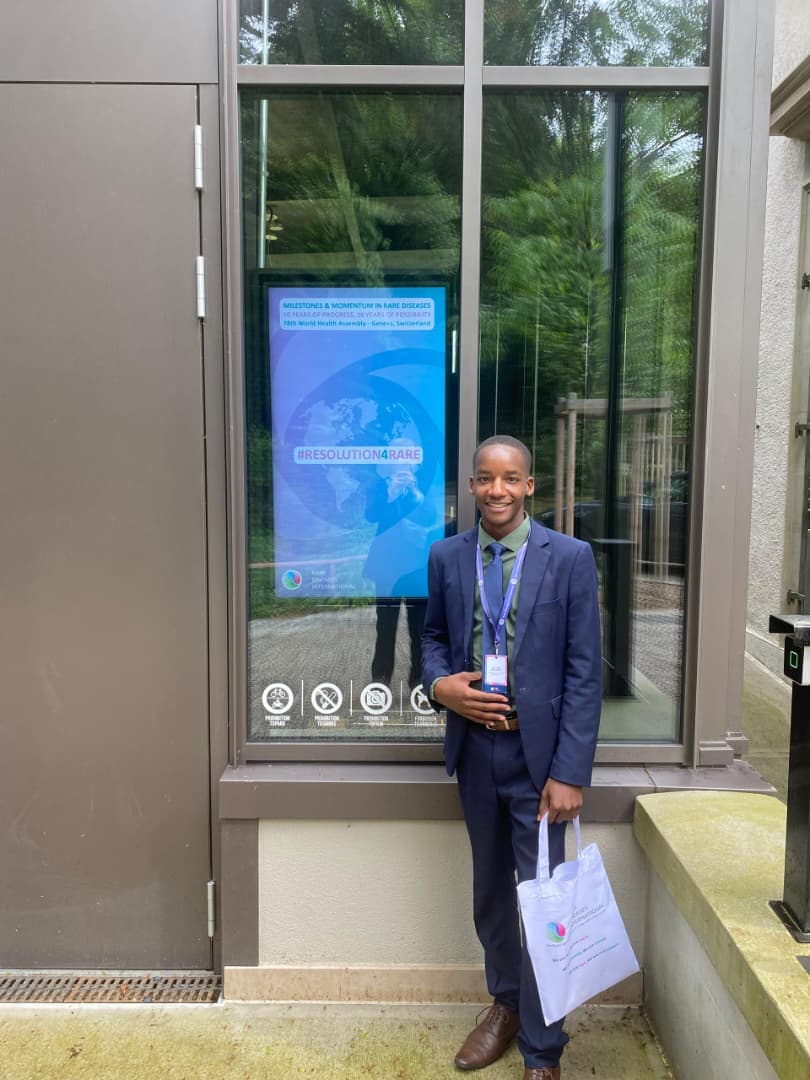
For Mugwati, data is the first step toward reform. “We need a national rare-disease registry,” he asserts. “Without it, policymakers can’t make informed decisions. Budgets are drawn blindly, and patients suffer.”
Despite these challenges, Mugwati sees hope in Zimbabwe’s younger medical professionals. Modern curricula now introduce modules in precision medicine, genomics, and biomedical sciences. “Young doctors can adopt what I call a ‘rare-way mindset,’” he explains. “When common diagnoses fail, they should ask: could this be something rare? That mindset alone could save countless lives.”
Emerging technologies, from genomic screening to telemedicine and AI-assisted diagnostics, also offer promise, but only if the healthcare system is prepared. “Early detection could transform outcomes,” Mugwati says. “But strong policies, data privacy regulations, and trained medical personnel are essential. Technology alone isn’t enough; it must be combined with education and patient-centered care.”
His vision is ambitious but clear: a national rare-disease ecosystem with a fully functional registry, specialized clinics, genetic services, integrated care pathways, and a patient-centered approach. “I want doctors who can diagnose rare diseases early, a health system that treats patients with dignity, and policymakers who plan based on evidence, not guesswork,” he says.
Mugwati’s work resonates strongly with the mission of the National Press Foundation (NPF), a U.S.-based nonprofit that equips journalists and advocates to shine a light on underreported health issues. NPF emphasizes storytelling that drives policy, community engagement, and evidence-based reform. While Mugwati is not a participant in NPF programs, his advocacy mirrors the foundation’s principles: using data, patient narratives, and grassroots campaigns to promote systemic change.
During the 2025 NPF Reporting on Rare Diseases Fellowship, journalists engaged with young advocates worldwide who shared experiences remarkably aligned with Mugwati’s observations. Presenters included Dimitrios Athanasiou, Rare Disease Patient Advocate; Phillip Langat, Founder of the Motor Neuron Disease Association of Kenya; Fernando Goldzstein, Founder of the Medulloblastoma Initiative; and Sarita Edwards, Founder of E.WE Foundation and rare-disease parent advocate. They highlighted delays in diagnosis, systemic barriers, and the role of youth and caregivers in shaping rare-disease advocacy across Africa, Europe, and the Americas. Their stories emphasized the power of data-driven reporting, digital engagement, and innovative solutions to improve patient outcomes.
Mugwati’s initiatives, digital awareness campaigns, school outreach, advocacy for registries, and pushing for policy inclusion, echo these lessons. “Every time we educate a family, every time we help a patient access care, we’re contributing to a system that is accountable and humane,” he says. “That is exactly what NPF encourages in journalists and advocates: using information to empower and protect communities.”
By bridging local realities with global insights, Mugwati’s work demonstrates how young advocates can build resilient, patient-centered health systems even in resource-limited settings. His story highlights the universal need for recognition, early diagnosis, and equitable care for rare-disease patients, a mission that transcends borders and resonates with advocates worldwide.
“Advocacy is not easy,” he admits. “Sometimes it feels like no one is listening. But the resilience I’ve seen among people living with rare diseases in Zimbabwe keeps me going. Even if we reach one person at a time, that person becomes a lifeline for someone else. That is how change begins.”



More Stories
AHF calls for African countries to unite against debt crisis
Zimbabwe’s Second Bid to Remove Vendors from Harare Streets Triggers Fresh Livelihoods, Law and Order Clash
AHF urges young people to priorities STI prevention and testing