






It Wins Farmer Confidence at Debut Interface…
By Shingirai Vambe
In what observers describe as a more robust and strategic repositioning, the fast-evolving National Employment Council for the Agricultural Industry in Zimbabwe (NEC Agriculture) has intensified its nationwide engagement drive, a move that is steadily reshaping perceptions within Zimbabwe’s agricultural sector.
Long associated primarily with dispute resolution and collective bargaining processes, the employment council is now deliberately broadening its mandate beyond arbitration rooms and statutory negotiations. Its latest outreach initiative in Chiredzi signalled a clear shift in tone, from regulator to partner, from enforcer to facilitator of sustainable industrial relations.
For years, employment councils across sectors have largely been viewed through a narrow lens, institutions that intervene when disputes arise, negotiate Collective Bargaining Agreements (CBAs), and enforce minimum employment standards.
But NEC Agriculture appears determined to recalibrate that perception.
In recent months, the council has engaged labour experts and consultants to train its staff and Councillors, focusing on mindset transformation and strategic repositioning. The emphasis has moved toward fostering constructive employer-employee relationships, building trust, and strengthening sector-wide collaboration.
The approach, according to insiders, is anchored in a simple but powerful principle, healthy industrial relations are not built in courtrooms, they are nurtured through dialogue, education and sustained engagement.

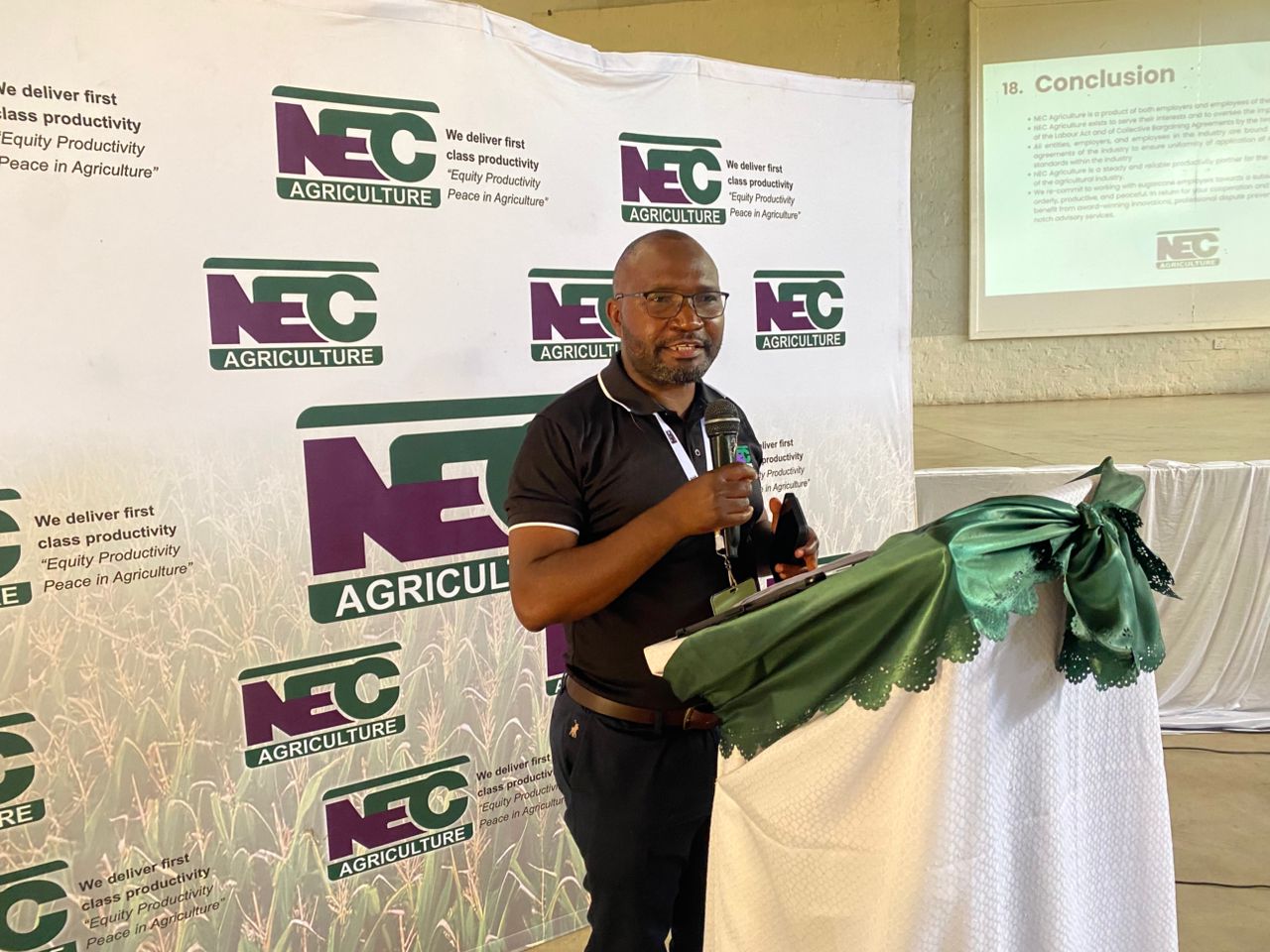
Last week, NEC Agriculture convened sugarcane employers and their representatives in Chiredzi, the epicentre of Zimbabwe’s sugarcane subsector. The engagement brought together representatives from the Ministry of Public Service, Labour and Social Welfare, the Zimbabwe Sugarcane Growers Apex Council, employer associations and industry leaders.
Addressing delegates, NEC Agriculture Chief Executive Officer David Madyausiku described the meeting as both timely and necessary.
“I am immensely humbled to stand here supported by all of you, gathered as we are here in your heartland of Chiredzi,” he said.
We meet at an opportune juncture where there is much to discuss, where there are relationships to cement, and where we must set ourselves on the same page.”
Madyausiku acknowledged that many employers remain unfamiliar with the full scope of the council’s operations. Part of the new strategy, he explained, is to demystify misconceptions and conscientise farmers about the council’s statutory role, not as an adversary, but as a trusted industrial relation’s advisory service provider.
“There is no NEC Agriculture without the hardworking farmers and farm employees of this industry,” he said. “Our success is ploughed back into dividends of service to the industry,” added Madyausiku.
The sugarcane subsector, a cornerstone of Zimbabwe’s agricultural economy, plays a critical role not only in food production but also in manufacturing, energy generation and emerging material sciences.
Recognising its importance, NEC Agriculture has established a permanent regional office in Chiredzi staffed by three full-time officers to provide continuous advisory services and oversight.
Among the key issues presented during the workshop was the recently gazetted Job Evaluation Report for the sugarcane subsector, formalised as Statutory Instrument 224 of 2025. The instrument sets out job classifications and grading structures within the industry, a development expected to bring clarity and uniformity to remuneration frameworks.
The council also showcased its translation of the principal CBA into vernacular languages, expanding accessibility in line with the 2013 Constitution. This initiative has positioned NEC Agriculture as one of the few employment councils to widen linguistic access to industry agreements.
Additionally, emphasis was placed on occupational safety and health reforms. The council’s Occupational Safety, Health and Environment CBA, alongside the active Health and Safety Committee established within the council, aligns with broader national efforts, including the recently published Occupational Safety and Health Bill currently under parliamentary consideration.
Madyausiku described the agricultural industry as operating in “a time of great complexity, but also great optimism.” With agriculture identified as a key pillar under Zimbabwe’s Vision 2030 strategy, the success of subsectors such as sugarcane carries national significance.
However, he cautioned that progress hinges on cooperation.
“Cooperation guarantees success. Divisions destroy the prospects of it,” he said, urging unity among farmers, employees and the employment council.
NEC Agriculture’s recent engagements suggest an institution consciously reinventing itself. By investing in internal training, expanding regional presence, socialising statutory reforms and prioritising dialogue over confrontation, the council appears intent on strengthening resilience within the agricultural labour ecosystem.
Farmers in Chiredzi, told this publication that the renewed outreach has reportedly generated cautious optimism. Many acknowledge that while statutory compliance remains necessary, a collaborative industrial relations environment may ultimately provide greater stability for productivity and growth.
Mrs Trish Mashiri, a 28-hectare sugarcane farmer, told The Post On Sunday that the meeting was one of the most impactful engagements she has attended this year.
“For a long time, many of us believed NEC was only about revenue collection, that its primary interest was collecting money from farmers. But that is not the true nature of NEC Agriculture,” she said.
Mashiri added that the council’s decision to engage farmers directly on the ground and clarify its mandate had shifted perceptions within the sector.
“Their humble approach in coming to us and demystifying these misconceptions has changed the way most of us view the council,” she said.
Whether this repositioning will translate into lasting structural harmony across Zimbabwe’s agricultural sector remains to be seen, NEC Agriculture is no longer content with being seen solely as an arbiter of disputes, it is positioning itself as a partner in progress, and asking the sector to walk the journey with it.




More Stories
Retrenchment Axe Hangs Over TelOne
Marital Feud Escalates Into Gun Drama in Rusape
Zimbabwe’s Export Engine Fires Up