





By Shingirai Vambe
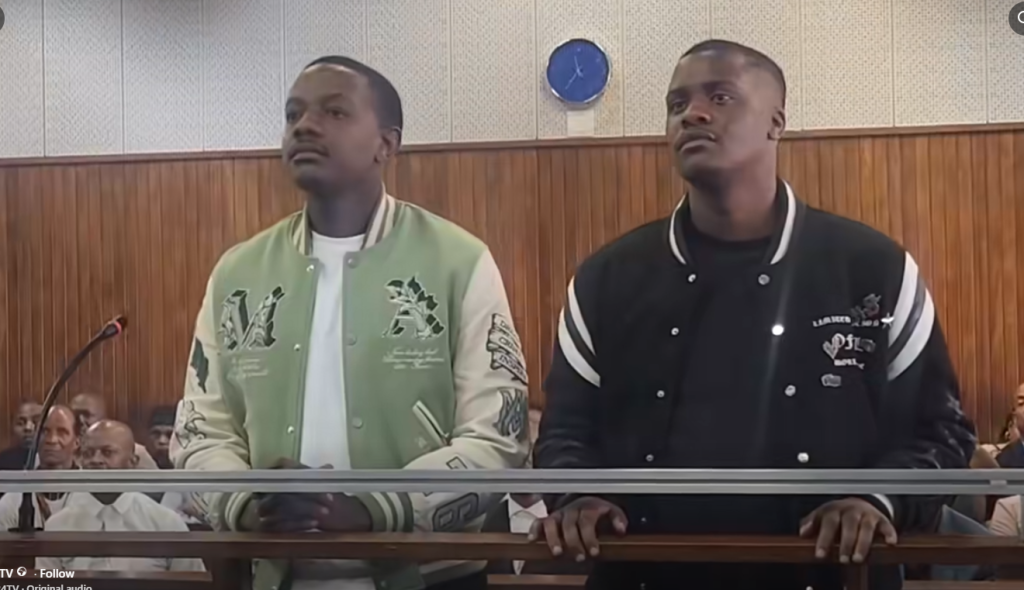
The Johannesburg courtroom drama that has gripped both Zimbabwe and South Africa reached a decisive conclusion this week, as the son of former President Robert Mugabe walked free while his cousin was handed a custodial sentence, drawing a sharp line between leniency and punishment in a case defined by violence, privilege, and consequence.
At the centre of the ruling was Bellarmine Chatunga Mugabe, who avoided imprisonment after the court imposed substantial financial penalties, and his co-accused cousin Tobias Matonhodze, who will now serve time behind bars following his conviction on multiple serious charges.
Delivering judgment on April 29, 2026, at the Alexandra Magistrates’ Court, the presiding magistrate underscored that the court had carefully weighed both justice and fairness in determining the fate of the two men. While acknowledging that both had already spent more than two months in custody awaiting sentencing, the court was unequivocal in its stance on accountability.
“Entitlement and arrogance should not control us,” the magistrate remarked, signaling a broader rebuke of conduct often associated with high-profile individuals. At the same time, the court emphasized that its decision sought to balance justice with mercy, though, as noted, “mercy is not sympathy.”
For Chatunga Mugabe, the outcome was a financial reckoning rather than incarceration. He was fined R400,000 for the firearm-related offence, with an alternative sentence of 24 months in prison should he fail to pay, and a further R200,000 for violating immigration laws, carrying an 18-month alternative sentence. The court also ordered his immediate deportation, with immigration officials tasked to escort him out of South Africa.
His conviction followed a guilty plea to pointing a firearm and residing unlawfully in the country. However, he distanced himself from the attempted murder charge linked to the February 19, 2026 shooting incident at a Hyde Park residence. His legal team had earlier indicated his readiness to pay fines and even cover deportation costs, factors that may have influenced the court’s decision to avoid a custodial sentence.
Co-accused, Tobias Matonhodze faced the full weight of the law.

Having pleaded guilty to a series of grave offences, including attempted murder, obstructing the course of justice, and unlawful possession of both a firearm and ammunition, he was handed a composite sentence that ultimately translates to three years of direct imprisonment.
The court structured his punishment as follows, 12 months for attempted murder, another 12 months for defeating the ends of justice, three years for unlawful firearm possession, and a further 12 months for ammunition-related offences. While these sentences will run concurrently, the effective term remains three years. Upon completion, he too will be deported to Zimbabwe.
The charges stem from a violent confrontation in February at a luxury residence in Hyde Park, where a security guard, Sipho Mahlangu, was shot in the back while attempting to flee. The incident shocked observers not only for its brutality but also for the high-profile identities of those involved.
Complicating the case further was the revelation that the victim later withdrew his complaint after receiving R400,000—raising uncomfortable questions about justice, influence, and the role of private settlements in criminal proceedings. Notably, the firearm used in the shooting was never recovered, an issue that investigators highlighted during the trial.
Ultimately, the case has left a divided public discourse.
On one hand, it reinforces the principle that the law can, at times, draw firm boundaries regardless of status. On the other, it has reignited debate over whether justice is applied evenly, particularly when wealth and political lineage intersect with criminal accountability.
While the scales of justice may seek balance, the outcomes they produce can still speak volumes about the complexities of power, responsibility, and consequence in modern society.



More Stories
Marital Feud Escalates Into Gun Drama in Rusape
Zimbabwe’s Export Engine Fires Up
Southern Africa Rethinks Energy Security as Zimbabwe Pushes Regional Power Integration