





By Shingirai Vambe
The brotherhood of Africa’s liberation movements has long been celebrated as a bond of shared struggle and sacrifice, a relationship forged in blood, solidarity, and the dream of freedom. Yet, decades after independence, this fraternity has increasingly become a hollow echo of past heroism, one that now masks the betrayal of the very citizens these movements once vowed to liberate.
From Harare to Pretoria, Lusaka to Windhoek, the rhetoric of unity and sovereignty continues to ring loud during election seasons, the familiar speeches about defending the revolution, resisting Western puppets, and safeguarding hard-won independence. But once the ballots are counted and power is retained, the song changes. Behind closed doors, those once hailed as revolutionaries become defenders of privilege and patronage, while ordinary citizens continue to suffer under economic mismanagement and corruption.
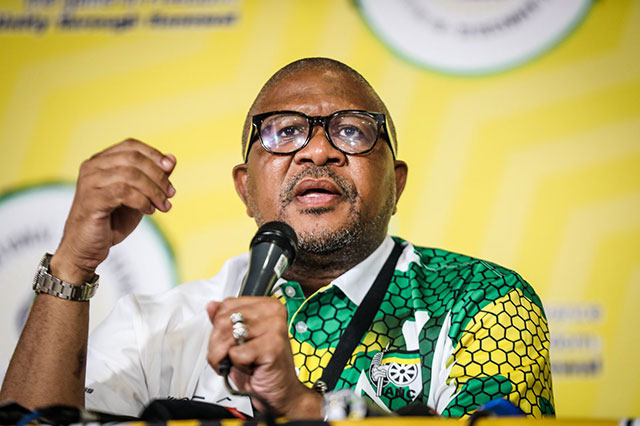
This week, those simmering contradictions were laid bare by African National Congress (ANC) Secretary General Fikile Mbalula, who broke ranks with the usual liberation movement niceties to deliver a stark and unfiltered assessment of Zimbabwe’s tragic decline, and a sobering warning for South Africa.
Speaking in a recent interview with Dr. Mbuyiseni Ndlozi on Power 98.7, Mbalula did not mince his words. He described Zimbabwe as “a rubble,” its economy and institutions destroyed in the aftermath of the chaotic and violent land reform programme of the early 2000s.
“If you want to see white people running in their numbers out of this country and to the United States, redistribute the land,” Mbalula warned.
“And then this country will turn into rubble, like Zimbabwe.”
His remarks, delivered with characteristic candour, have reignited debate across the region, not only about land reform, but about the broader crisis of governance that continues to afflict many former liberation states.
Zimbabwe’s land reform was born of genuine grievance, a demand for justice after decades of colonial dispossession. But when it finally arrived, it did so not through structured reform but through chaos and violence. White commercial farmers were forcibly evicted, production collapsed, and the country’s breadbasket economy crumbled.
Mbalula’s comments acknowledged what many in the region whisper but few in leadership dare to say publicly: that Zimbabwe’s collapse was self-inflicted, a product of political expedience and greed, not revolutionary necessity.
“When the liberation was fought,” a Zimbabwean political analyst Ronald Mushoriwa told The Post On Sunday, “no one fought under the banner of ZANU or ZAPU or ANC. People fought for freedom, for land, for dignity. But today, that legacy has been captured by political elites who use it as a shield for their own corruption.”
Indeed, in Zimbabwe, land reform has largely benefited those with proximity to power, senior party officials, military figures, and loyalists of the ruling elite, while ordinary peasants remain trapped in poverty.
At the centre of Mbalula’s comments is Section 25 of South Africa’s Constitution, which governs property rights and provides for land expropriation with “just and equitable compensation.” The clause has long been contested, with factions inside and outside the ANC calling for land redistribution without compensation, arguing that true liberation remains incomplete without economic redress.
In January 2025, President Cyril Ramaphosa signed the Expropriation Bill, paving the way for limited land seizures without compensation, a move celebrated by some as a long-overdue act of justice, but feared by others as a step toward Zimbabwe’s path.
Mbalula, while affirming the need for redistribution, struck a tone of caution. He said land expropriation must not become a political tool that plunges the country into chaos.
“If a loaf of bread is going to be R500 because of land redistribution, like in Zimbabwe, where will the people of South Africa run to?” he asked.
“Zimbabweans are running to South Africa. We’ve got nowhere to run.”

It was a grim but honest reflection of reality, that South Africa’s poor would bear the brunt if reforms were mishandled.
For years, the ANC and Zimbabwe’s ZANU–PF have maintained a public show of solidarity, often defending each other against Western criticism. Yet, Mbalula’s comments mark a rare moment of introspection within that fraternity, a recognition that loyalty to liberation movements cannot come at the expense of truth or progress.
Analysts say this candour could signal a shift within the ANC, which has seen its dominance wane after losing its parliamentary majority in the 2024 elections. The formation of a Government of National Unity (GNU) has brought new political pressures and forced the party to confront uncomfortable realities, including those mirrored across the Limpopo.
“The liberation generation built powerful political machines, but they also built walls around themselves,” said a South African governance expert. “What Mbalula has done is pierce that wall, even if just slightly. It’s a call for reflection, that independence was not the destination; it was only the beginning.
Across Africa, the rhetoric of liberation continues to dominate public life, yet it often conceals the very failures the revolution sought to end. Citizens who question the status quo are branded “sellouts” or “puppets of the West,” while those who speak the truth are sidelined or silenced.
But as Mbalula’s words remind the region, truth ignored is truth delayed, and delay is costly. Zimbabwe’s once-thriving economy now serves as a cautionary tale, a mirror reflecting what happens when power goes unchecked, and policy becomes a weapon rather than a tool for justice.
Mbalula’s statement was not merely a political jab, it was a warning, perhaps even a confession, that liberation without accountability is a betrayal of the very struggle that birthed modern Africa.
“When we talk of land, when we talk of justice, we must do so with wisdom,” he said. “Otherwise, we destroy what our heroes built.”
For millions in Zimbabwe, across the region and many in South Africa watching anxiously, those words may have come decades late, but they carry the weight of lived truth.


More Stories
Retrenchment Axe Hangs Over TelOne
Marital Feud Escalates Into Gun Drama in Rusape
Zimbabwe’s Export Engine Fires Up