



By Senior Reporter
South Africa’s President Cyril Ramaphosa has found himself caught between two increasingly difficult realities: the country’s longstanding commitment to African solidarity and growing domestic anger over illegal immigration, unemployment, crime and pressure on public services.
Ramaphosa’s decision to apologise to leaders of the Southern African Development Community (SADC) over recent attacks and harassment of foreign nationals has triggered a backlash among sections of South African society, with protesters arguing that the President has placed regional diplomacy ahead of the concerns of citizens struggling with deteriorating economic and social conditions.
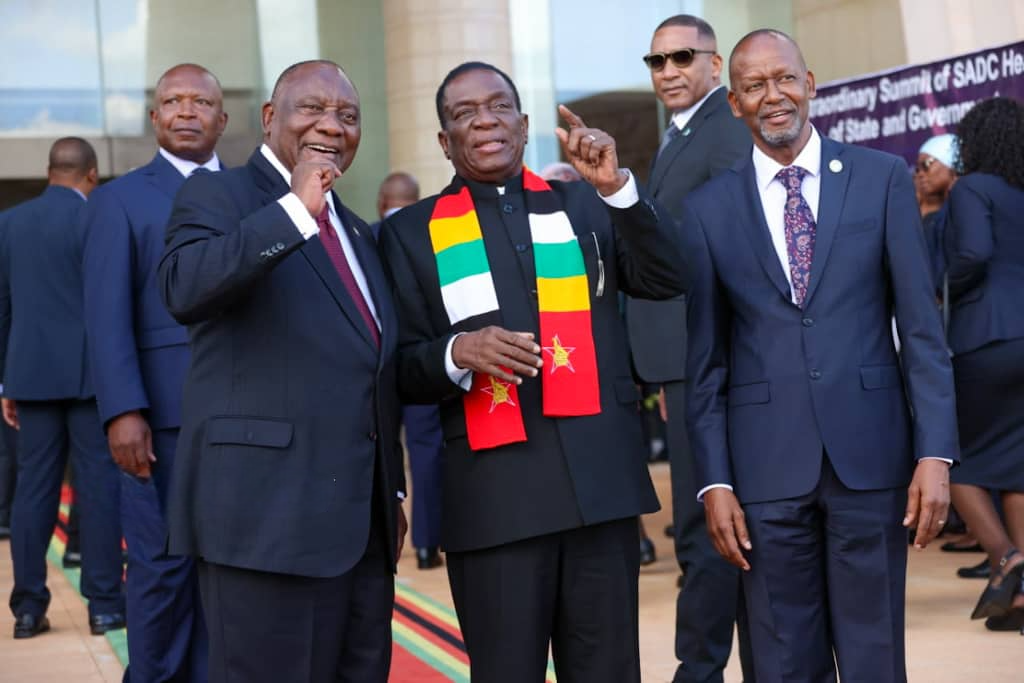
The controversy unfolded as regional leaders gathered in Durban for the 46th Ordinary Summit of SADC, a meeting intended to strengthen regional cooperation at a time when southern Africa is facing a complicated mix of economic hardship, political instability, migration pressures and growing public frustration with governance.
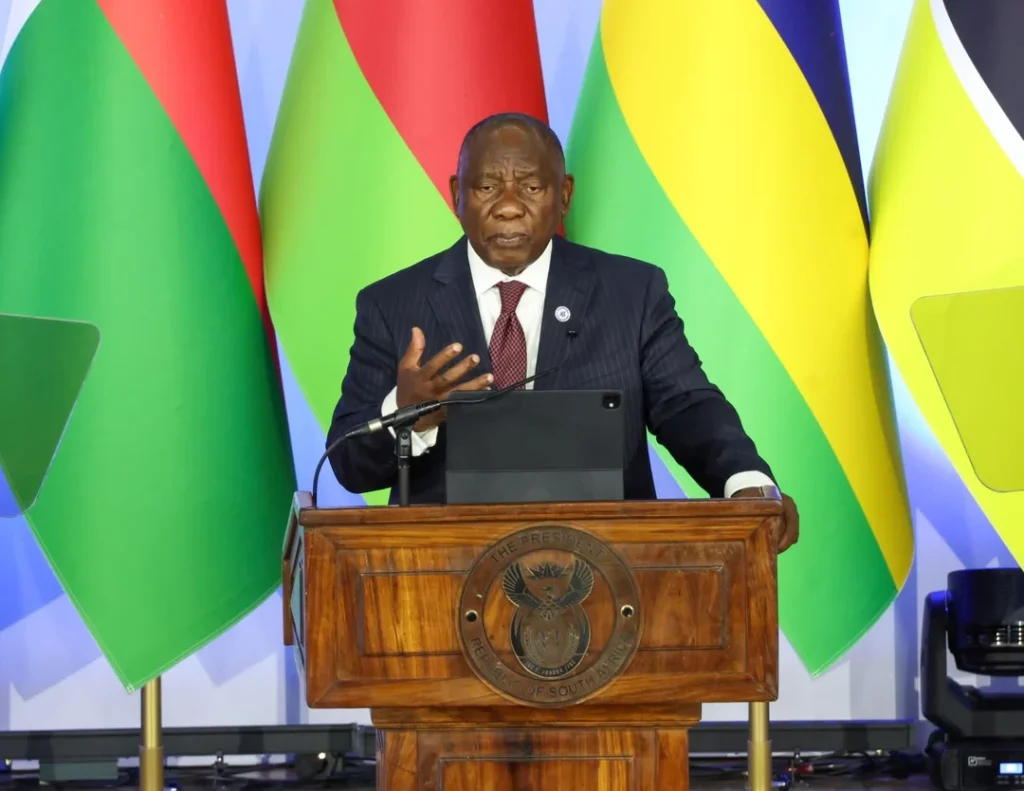
Speaking ahead of the summit, Ramaphosa acknowledged the treatment of foreign nationals and expressed deep concern over attacks directed at people from neighbouring countries who had travelled to South Africa in search of employment, business opportunities and a better standard of living.
“As South Africans, we are deeply concerned and ashamed that nationals from other countries have in recent months been subjected to discrimination and ill-treatment,” Ramaphosa said.
He argued that the actions of a minority should not be allowed to define South Africa’s relationship with the rest of the continent.
“The criminal actions of a few within our communities are a repudiation of the solidarity upon which this community was founded. We cannot preach integration at summits and practise exclusion in the streets,” he said.
But the President’s remarks have not been universally welcomed.
For some South Africans, the apology represents an admission of national failure without sufficiently acknowledging the frustration driving anti-immigration sentiment.
The protests have been driven by groups demanding that undocumented foreign nationals leave South Africa, with organisers linking illegal migration to rising crime, unemployment, pressure on housing and public services, and competition for economic opportunities.
Among the organisations challenging Ramaphosa’s position is March and March, which has criticised the President for apologising to SADC leaders over what it describes as legitimate concerns about undocumented migration.
March and March leader Jacinta Ngobese-Zuma reportedly rejected the President’s apology, arguing that South Africans have nothing to apologise for while their own communities continue to struggle with unemployment, poverty and insecurity.
The organisation staged a prolonged protest outside the Durban Convention Centre, where the SADC Summit was being held, putting migration firmly on the agenda surrounding the regional gathering.
The protesters handed a memorandum to the police addressed to SADC leaders, demanding that governments take responsibility for their citizens living in South Africa without valid documentation.
The message reflects a growing sentiment among some South Africans that neighbouring governments should do more to address the economic and political conditions that push their citizens to seek opportunities across borders.
South Africa remains the region’s largest economy and a major destination for migrants from across southern Africa.
Zimbabweans, Mozambicans, Malawians and other African nationals have for years crossed into South Africa, legally and illegally, in search of employment, education, business opportunities and improved living conditions.
The migration flows have, however, increasingly become politically sensitive.
South African authorities have intensified immigration enforcement, while groups opposed to undocumented migration have become increasingly vocal.
The situation deteriorated around the June 30 demonstrations, when groups gave undocumented migrants what they described as a deadline to leave the country.
Reports of foreign-owned businesses being looted, migrants being attacked and families being forcibly removed from their homes deepened concerns about the safety of foreign nationals.
The incidents also placed the South African Government under increasing pressure to demonstrate that immigration enforcement would be conducted through the law rather than through vigilantism.
South African officials have sought to distinguish between legitimate enforcement of immigration laws and attacks against foreigners.
On the sidelines of the SADC Summit, South African representatives have reportedly assured neighbouring governments that the violence and harassment were the actions of individuals and groups and did not represent official government policy.
The challenge for Ramaphosa, however, is that the anger is no longer confined to isolated anti-immigration groups.
South Africa’s economic difficulties have created fertile ground for political mobilisation around migration.
High unemployment, particularly among young people, weak economic growth, rising living costs and concerns about access to public services have combined to create an increasingly hostile environment for undocumented migrants.
Foreign nationals have consequently become convenient targets for broader frustrations that extend well beyond migration itself.
Critics of the anti-immigration campaigns argue that the focus on migrants risks obscuring deeper structural problems within South Africa, including corruption, poor governance, weak economic growth, inadequate service delivery and the failure to create sufficient employment opportunities.
The migration debate has also exposed the contradictions within regional integration.
SADC has repeatedly promoted regional cooperation, economic integration, free movement and cross-border trade, yet millions of Africans continue to encounter restrictive immigration regimes when attempting to move within the region.
South Africa’s position is particularly complicated because its economy depends heavily on regional trade and migrant labour, while political pressure at home increasingly demands tighter control of immigration.
The situation has also reopened questions about the effectiveness of SADC itself.
Economic and political crises in several member states have placed the regional bloc under sustained scrutiny, with critics accusing it of being too slow or ineffective in responding to political instability and governance failures among member states.
In Zimbabwe, for example, SADC has repeatedly faced criticism over its handling of political disputes and electoral controversies, particularly where opposition parties and civil society groups have argued that regional intervention has failed to produce meaningful democratic reforms.
Economic and political instability elsewhere in the region has similarly contributed to migration pressures, creating a cycle in which citizens leave countries experiencing economic hardship and move towards relatively stronger economies such as South Africa.
The controversy has therefore placed SADC at the centre of a much larger debate: whether the regional organisation can effectively address the underlying causes of migration rather than simply managing its consequences.
The Economic Freedom Fighters leader Julius Malema has gone even further, describing SADC as little more than a “gentlemen’s club” and questioning its relevance in addressing the region’s most pressing political and economic problems.
Malema has argued that the organisation has become overly protective of political elites and liberation-era leaders while failing ordinary citizens confronting poverty, unemployment and poor governance.
His criticism adds another dimension to the growing debate over whether SADC remains fit for purpose in an increasingly complex southern African political and economic environment.
For Zimbabwe, the migration debate carries particular significance.
Large numbers of Zimbabweans have historically moved to South Africa because of economic hardship, unemployment and limited opportunities at home. Many have established businesses, entered the labour market or built families in South Africa.
The treatment of Zimbabwean migrants therefore has direct consequences for both countries.
At the same time, South African authorities argue that undocumented migration places additional pressure on state systems and complicates law enforcement.
The challenge is to distinguish between migration itself and criminality.
Foreign nationals should not automatically be associated with crime, just as the existence of undocumented migrants does not remove the responsibility of governments to enforce immigration laws.
The growing hostility towards foreigners nevertheless demonstrates how quickly migration can become a political weapon when economic conditions deteriorate.
Ramaphosa’s apology was therefore more than a diplomatic gesture.
It was an attempt to defend the principles upon which regional integration was built while simultaneously acknowledging the reality that South Africa’s domestic political landscape is becoming increasingly hostile to undocumented migration.
His message to SADC leaders was essentially that South Africa cannot demand cooperation from its neighbours while allowing violence against their citizens within its own borders.
But the protests outside the summit demonstrated the limits of that argument.
For many South Africans, the question is no longer simply whether foreign nationals should be welcomed. It is whether the government has the capacity to manage migration effectively, protect citizens, enforce immigration laws and create an economy capable of absorbing both South Africans and migrants without intensifying competition over scarce opportunities.
The answer cannot simply be found in deportations, border enforcement or diplomatic apologies.
It lies in addressing the deeper conditions driving migration across southern Africa: economic inequality, unemployment, poverty, political instability, weak governance and inadequate opportunities for young people.
Until those problems are addressed, migration will remain both a symptom of regional inequality and a source of political tension.
The Durban SADC Summit has consequently exposed an uncomfortable reality.
Africa may speak passionately about integration, solidarity and a borderless future, but millions of Africans still experience the continent through the harsh realities of borders, documentation requirements, unemployment, poverty and xenophobia.
Ramaphosa’s apology may have been intended to reaffirm African solidarity.
Instead, it has opened a much broader conversation about who belongs, who is responsible for migration, and whether SADC governments are doing enough to make it possible for Africans to build dignified lives in their own countries rather than being forced to seek a future elsewhere.
The deeper question confronting southern Africa is therefore not simply how to deal with undocumented migrants.


More Stories
AHF calls for African countries to unite against debt crisis
Pensioners Left Waiting As Billions Sit In Zimbabwe’s Pension Funds
Tax, Trust and Financial Literacy- Zimbabwe’s Long Struggle With the Obligations of a Modern Economy