






AI, Innovation and Inclusion…
By Shingirai Vambe
As Zimbabwe joined the rest of the world in commemorating International Girls in ICT Day 2026, the country’s growing ambitions to position itself as a regional technology and innovation hub were placed firmly under the spotlight, with government officials, technology experts, students and industry leaders calling for urgent action to close the country’s widening digital divide.
Held at the National University of Science and Technology in Bulawayo under the theme “AI for Development: Girls Shaping the Digital Future,” the commemorations became more than just another annual calendar event. They evolved into a national conversation about artificial intelligence, digital inclusion, innovation, access to technology and the future role of girls and women in Zimbabwe’s emerging digital economy.
For Zimbabwe, the event came at a defining moment.
The country recently launched its National Artificial Intelligence Strategy 2026–2030, positioning AI, digital transformation and emerging technologies at the centre of its broader economic and industrialization agenda.
Government believes the future economy will increasingly depend on software engineering, robotics, cybersecurity, coding, data science and smart technologies.
Yet beneath the optimism surrounding Zimbabwe’s digital ambitions lies a deeper reality, millions remain disconnected, particularly in rural communities where access to gadgets, electricity, internet connectivity and digital literacy remains severely limited.
While the country continues expanding network infrastructure and broadband access through operators such as NetOne, Econet Wireless Zimbabwe, Telecel Zimbabwe, TelOne and Starlink, the affordability of devices remains one of the biggest barriers preventing ordinary citizens from participating meaningfully in the digital economy.

In many remote communities across Matabeleland North, Binga, Lupane, Hwange, Tsholotsho, Mbire and parts of Mashonaland Central, internet signals may now exist, but smartphones, tablets and laptops remain luxuries beyond the reach of many households.
The reality sharply contrasts with the rapid pace at which the world is moving toward artificial intelligence-driven economies.
Zimbabwe’s Minister of ICT, Postal and Courier Services, Tatenda Mavetera, recently acknowledged that most digital devices used in Zimbabwe continue to be imported at significant cost from overseas markets, particularly from Asia.
Universities and local innovators are now scrambling to develop locally manufactured technological gadgets and systems that could potentially reduce costs and improve accessibility for ordinary citizens.
One local technology innovator manufacturing vehicle monitoring set boxes told The Post On Sunday that Zimbabwean developers are still heavily dependent on foreign countries for hardware production.
“We are designing the boards locally, but we still have to send the designs to China for manufacturing, and that comes at a huge cost,” the innovator said.
“That means even when Zimbabweans innovate, the actual production process still depends on external markets, which increases prices and delays development.”
The challenge reflects the broader dilemma facing many African countries seeking to transition into the Fourth Industrial Revolution while lacking sufficient manufacturing ecosystems, funding, semiconductor industries and research infrastructure.
Despite these obstacles, Zimbabwe’s ICT sector is increasingly showing signs of growth and transformation.
At the centre of this transformation is the girl child.
Speaking during the global commemorations of International Girls in ICT Day held in Tirana, Albania, the Director of the Telecommunication Development Bureau at the International Telecommunication Union, Cosmas Zavazava, warned that excluding girls from artificial intelligence and digital innovation would worsen global inequality.
Under the theme “Building With, Not Just For: The Genius of Girls in the Digital Age,” Zavazava described AI as one of the most transformative forces shaping humanity, but cautioned that the people building these systems often do not reflect the communities most affected by them.
“Globally, men are nearly twice as likely as women to have digital skills. Only 22 percent of AI professionals are women. And in low-income countries, the gap is even steeper, a girl is 1.3 times more likely to be digitally excluded than a boy her age,” Zavazava said.
“What happens when we leave girls out of the AI revolution? We get biased facial recognition, health algorithms that misdiagnose female patients, and job platforms that recommend women for lower-paid roles, automating inequality instead of solving it.”
Zavazava argued that girls should no longer be viewed merely as users of technology, but as creators, innovators and developers capable of solving real-world problems.
He cited examples from across the developing world where young girls had already begun building impactful technological solutions.
“In India, schoolgirls built an AI tool to detect early signs of depression in classmates. In Brazil, girls trained computer vision models to identify blocked drainage systems to help prevent floods. In Uganda, a 17-year-old created a voice-based AI assistant for farmers who cannot read,” he said.
“This is not charity. This is research and development. Girls are among the most powerful innovation laboratories we have, if we invest in them.”
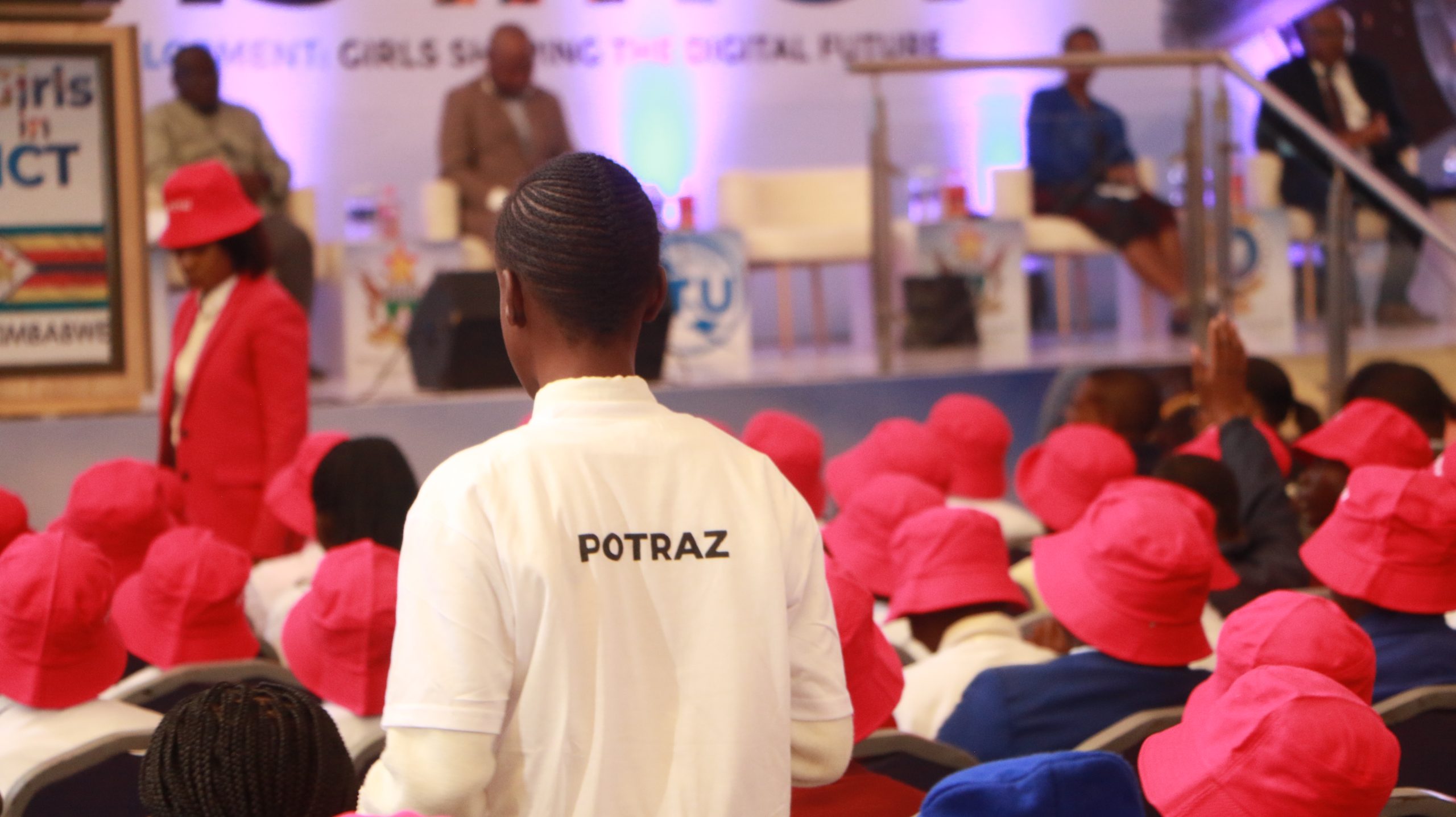
Those words resonated strongly inside the halls of NUST in Bulawayo, where over 1,200 girls from across Matabeleland provinces gathered for Zimbabwe’s national commemorations.
Inside the university auditorium, decorated with banners from POTRAZ and leading telecommunications companies, schoolgirls moved confidently between exhibitions, robotics demonstrations and digital innovation showcases while capturing selfies, recording videos and interacting with exhibitors using tablets, smartphones and laptops.
Among the most striking innovations showcased during the event was a safety system developed by a 17-year-old girl designed to help women and girls during dangerous situations and emergencies.
The project attracted significant attention from delegates and government officials, reinforcing the growing belief that young Zimbabwean girls possess enormous untapped technological potential.
For many attendees, however, the event also exposed the painful inequalities that continue to shape access to technology in Zimbabwe.
Charity Ncube from Solusi University told The Post On Sunday that while the commemorations were inspiring, they also highlighted the urgent need to take digital empowerment beyond urban centres and university campuses.
“Events like these matter for young girls in rural areas like Nkayi, Binga, Tsholotsho, Hwange and Lupane who have never seen a woman stand confidently in an ICT space and say, ‘This is my profession and this is where I belong,’” she said.
“When POTRAZ brings those girls onto a university campus, some of them are entering such a building for the first time in their lives, and that moment plants something in them.”
Ncube said the presence of over 1,000 girls at the Bulawayo event demonstrated growing interest in technology among young women, particularly in Matabeleland provinces where large-scale educational and technology events are often poorly attended.
But she warned that one-day commemorations alone were not enough to produce lasting transformation.
“My challenge is that these commemorations are once-off events,” she said.
“We come together, we celebrate, we dance, we take photos, and everyone goes back home. But who follows up afterward? Who checks whether those girls actually enroll in ICT programmes, graduate or enter the technology workforce?”
Ncube also questioned whether technology companies participating in such events were doing enough beyond branding exercises.
“We had companies like NetOne and TelOne supporting the event, which is good. But how many of them have structured mentorships, internships and long-term programmes specifically targeting girls from underserved rural communities?” she asked.
She called on government, POTRAZ and industry players to decentralize such programmes and take them directly into remote rural communities where access to electricity, internet connectivity and devices remains severely limited.
“I wish these commemorations could become year-round empowerment programmes with practical hands-on training for both students and teachers,” she said.
As the world rapidly moves deeper into artificial intelligence, automation and digital economies, Zimbabwe now faces a defining challenge, ensuring that technological transformation does not become another driver of inequality.
As Zimbabwe continues charting a path towards leaving no one and no place behind in its digital transformation agenda, inclusivity was also visible during last week’s International Girls in ICT commemorations at the National University of Science and Technology (NUST) in Bulawayo, where students living with disabilities actively participated in the event.
Learners with visual impairments, hearing impairments and other disabilities were part of the commemorations, reinforcing growing calls for technology and digital innovation to be accessible to all members of society regardless of physical limitations.
A request was made for Braille learning support materials, highlighting the urgent need for inclusive digital education tools capable of accommodating visually impaired students as Zimbabwe accelerates towards an AI-driven future.
In another touching moment, a teacher was seen communicating with her students through sign language while following presentations and exhibitions inside the auditorium, a scene that reflected both the challenges and possibilities surrounding inclusive access to technology and education.
For many delegates, the presence of students living with disabilities served as a powerful reminder that Zimbabwe’s digital revolution cannot only focus on connectivity and innovation, but must also ensure accessibility, inclusivity and equal participation for every citizen.
For many young girls who attended the commemorations in Bulawayo, however, the event represented possibility.
Possibility that technology is no longer a space reserved for men.
Possibility that a girl from Lupane, Binga or Tsholotsho can one day build systems powered by artificial intelligence.
Possibility that Zimbabwe’s future digital economy may not only be built in boardrooms and universities, but inside ordinary classrooms where young girls are already beginning to code, innovate and imagine solutions capable of transforming communities.
And perhaps most importantly, possibility that the future of Zimbabwe’s digital revolution may ultimately depend on how successfully the country connects, empowers and invests in its girls.




More Stories
Retrenchment Axe Hangs Over TelOne
Marital Feud Escalates Into Gun Drama in Rusape
Zimbabwe’s Export Engine Fires Up