





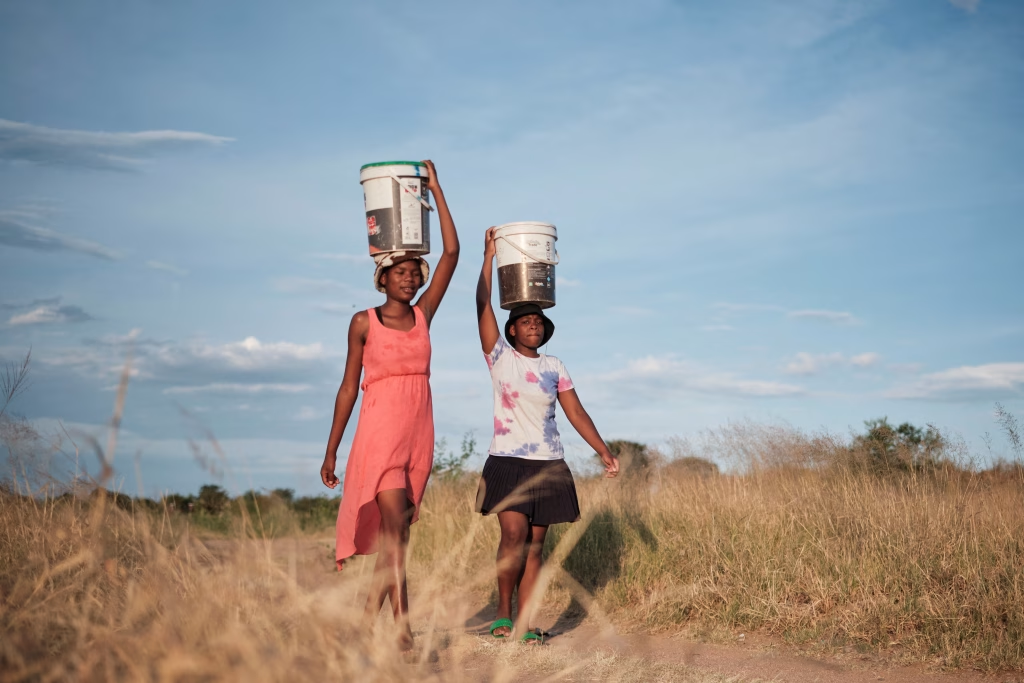
BRACES FOR ANOTHER CLIMATE SHOCK
By Shingirai Vambe
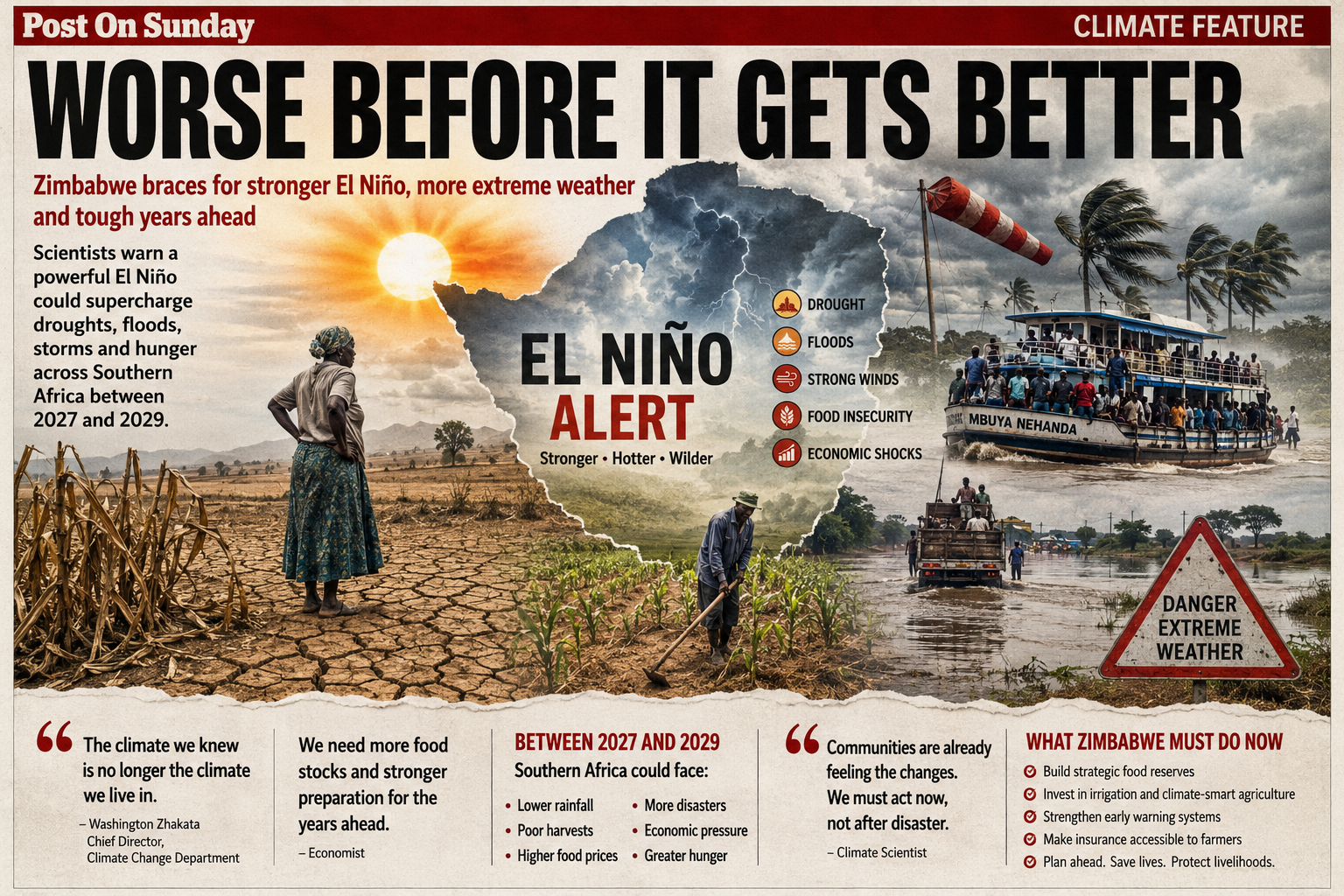
Zimbabwe and the wider Southern African region could be heading into another difficult climate cycle, with scientists warning that a potentially powerful El Niño event may compound an already fragile food and economic environment.
The warning comes at a time when communities across the region are still recovering from the effects of erratic weather, prolonged dry spells, destructive winds, flooding and unusual temperature patterns that have disrupted agriculture, transport, livelihoods and household incomes.
For Zimbabwe, the concern is particularly serious.
The country is emerging from a difficult agricultural season in which farmers experienced an unusual combination of weather extremes — good rains at the beginning of the cropping season, excessive rainfall in some areas during critical stages of crop development, followed by prolonged dry conditions.
The result has been crop losses in some farming communities, pressure on household food supplies and renewed questions about the country’s preparedness for another major climate shock.
Economists and food-security experts are already warning that Zimbabwe and other countries in the region may need to build stronger strategic food reserves ahead of potentially difficult years between 2027 and 2029.
The warning is not simply about rainfall, a serious climate shock can rapidly become an economic shock, poor harvests mean higher food prices and higher food prices put pressure on household incomes.
Governments are then forced to spend more on food imports and social protection, while farmers struggle to recover the money invested in seed, fertiliser, chemicals, labour and machinery.
For a country already battling high production costs and constrained household purchasing power, another poor agricultural cycle could have consequences well beyond the farm.
Zimbabwe Climate Change Department chief director Washington Zhakata has previously warned of shifting climate patterns and the increasing unpredictability of weather systems.
Those changes are becoming increasingly visible in everyday life and across Zimbabwe, communities have experienced weather conditions that do not necessarily conform to the traditional expectations associated with particular months.
The winter season has lingered in ways that have surprised many residents, with unusually cold mornings and evenings continuing into a period when temperatures would ordinarily begin rising significantly.
In some areas, people have continued wearing woollen hats, heavy jackets and other winter clothing well into the period traditionally associated with the transition towards warmer conditions.
The daily temperature pattern has also become increasingly erratic. Mornings can be bitterly cold, temperatures rise sharply during the afternoon, Strong winds can develop after midday and by evening, the cold returns.
For communities accustomed to predictable seasonal transitions, the changing pattern has become another reminder that climate change is not simply a scientific concept discussed at international conferences.
The devastating Lake Kariba disaster has brought another dimension of extreme weather into sharp focus.
Following the tragedy in which more than 95 people were reportedly killed after the Mbuya Nehanda ferry capsized, residents spoke of unusually strong winds and difficult weather conditions at the time of the incident.
Mbuya Norah Muchingami, a Kariba resident, described the weather conditions as particularly difficult, with strong winds emerging at a time when the region would normally be experiencing increasingly warmer temperatures.
The tragedy has raised questions about the need for improved weather monitoring, early warning systems and communication between meteorological authorities, transport operators and communities whose livelihoods depend on water.
Kariba is traditionally associated with heat, yet residents have experienced conditions that appear increasingly difficult to predict.
The contradiction is striking, a region known for high temperatures has, in recent weeks, continued experiencing cold mornings, chilly evenings and strong winds whereas such conditions are not necessarily evidence that every individual weather event is caused by climate change, but they demonstrate why communities need better access to reliable, localised and timely weather information.
The unusual conditions are not confined to Zimbabwe alone, across Southern Africa, weather patterns have become increasingly volatile, with different parts of the region experiencing contrasting extremes.
While some communities have been battling excessive rainfall and flooding, others have endured drought.
South Africa has also experienced snowfall in some areas during a period when other parts of the region would ordinarily be preparing for warmer conditions.
Such contrasts demonstrate the complexity of a changing climate.
Against this background comes the warning of another potentially powerful El Niño event, El Niño is a naturally occurring climate phenomenon associated with periodic warming of sea-surface temperatures in the eastern tropical Pacific Ocean.
It normally occurs every two to seven years and can influence weather patterns far beyond the Pacific. Its effects can include drought in some parts of the world and excessive rainfall in others.
For Southern Africa, El Niño has historically been associated with increased risks of drought and reduced rainfall in many areas, although the precise effects vary by season and location.
What is particularly concerning for scientists is growing evidence that human-induced global warming may be influencing the behaviour and intensity of El Niño events.
The implications are significant for countries that have contributed relatively little to global greenhouse gas emissions but remain highly exposed to climate shocks.
For Southern Africa, the climate crisis is becoming a question of inequality. The communities most vulnerable to climate shocks are often those with the fewest resources to adapt to especially smallholder farmers if the rains fail, the smallholder farmer loses the crop, if excessive rain destroys the crop, there may be no insurance payout.
If prices rise, the same farmer becomes a consumer struggling to purchase food and this creates a vicious cycle.
Climate change therefore threatens not only agricultural production but also household wealth, rural employment, food security and national economic stability.
Zimbabwe has become accustomed to responding to disasters after they occur. A drought is declared after crops have already failed, food imports are arranged after reserves begin running low, relief programmes are expanded after communities have exhausted their household stocks, emergency interventions are activated after infrastructure has been destroyed while climate change requires a different approach from reaction to anticipation.
The Kariba tragedy has demonstrated the devastating consequences that can occur when extreme weather meets human vulnerability.
Weather monitoring must therefore become part of transport safety, particularly for vessels, aircraft and long-distance road transport.
The future of food security may depend less on how much rain Zimbabwe receives than on how intelligently the country prepares for the rain it can no longer predict.



More Stories
Retrenchment Axe Hangs Over TelOne
Zimbabwe’s Export Engine Fires Up
Southern Africa Rethinks Energy Security as Zimbabwe Pushes Regional Power Integration